Beyond the Definitions
Axiom
I think this is self-evident. Nobody is outside the Universe. Note that “the Universe” is a black box here: We have no idea what else is in there. A consequence of the self-reflectivity is that there will be blind-spots. There are blind-spots in all systems that try to look at themselves. For example
The idea has much in common with Daoism.The Dao that can be told is not the eternal Dao...
- Gödel’s theorem in mathematics.
- Singularities in otherwise working models of the Universe.
- There is a blind-spot in each eye-ball. The blind-spot can only be observed in each eye separately, using a well known method that involves closing one eye and holding up two fingers.
- I have never seen my own eyes, the back of my own head, or even myself entirely, without using a mirror. If I use a mirror, I can’t see what is behind that. If I use another mirror to see what's behind the first one, I can’t see what is behind that. And so on indefinitely...
- A two-dimensional observer embedded in an unbounded two-dimensional surface will never see the point at which the surface intersects itself if it happens to do so (e.g. the observer is in the surface of a Klein bottle). And, even if the observer suspects that it is ultimately embedded in an object having more dimensions, it has no way to tell how many dimensions that object might have.
There is no way to
have any certain knowledge about the blind-spot, so its probable that neither our mathematics nor our language will be capable of describing it.
In the 1980s, I condensed this thought into a little poem:
In the 1980s, I condensed this thought into a little poem:
that more is
but beyond words
is will be misunderstood
but beyond words
is will be misunderstood
The idea has much in common with Daoism.
Perception and Consciousness
As defined above- perception is the process that begins when a sensory neuron fires.
- consciousness is the awareness of space and time (as separate entities).
Perception is our input interface to the outside Universe.
Note that this definition of perception includes both conscious and unconscious perception. When asleep, the senses of touch and hearing still affect the subconscious nervous system to which they are attached, but both senses have reduced range because we are immobile. When dreaming, our sense of sight seems to be connected to a strange world where space and time are less separated than they are when we’re fully conscious.
Note that this definition of perception includes both conscious and unconscious perception. When asleep, the senses of touch and hearing still affect the subconscious nervous system to which they are attached, but both senses have reduced range because we are immobile. When dreaming, our sense of sight seems to be connected to a strange world where space and time are less separated than they are when we’re fully conscious.
In dreamless sleep, when sight is switched off completely, we have no sense of space or time at all. We are (axiomatically) part of the Universe looking at itself, so dreamless sleep is presumably when our brains are just working in the way the Universe itself works (not in separate space and time).
Neuroscientists studying the behaviour of brains need to remember that they are studying objects and events in their own space and time. This is especially important when studying brains that are asleep and not dreaming!
According to these definitions, perception and consciousness are part of the strategy the Universe uses to look at itself. So while I agree completely with Donald Hoffman
that perception is an interface, and with Bernardo Kastrup’s “dashboard” model, I don’t agree that consciousness is fundamental to understanding the Universe as a whole. The Universe is larger, and more complicated than we can ever imagine because we are part of it.
This also means that I think metaphysical speculation about what is out there, beyond the dashboard, will go nowhere on its own.
Our best tool for investigating the way the Universe really works is mathematics combined with empirical experiments.
And the mathematics has to evolve as we understand more about what’s going on.
So, to be useful, metaphysical speculation needs to be used to suggest mathematical models and even, possibly, new mathematics.
Memories and Qualia
As defined above- memories are related to the current, evolving state of a brain.
- qualia are private, subjective sensations (e.g. the redness of red).
It’s only when conscious, that we have access to the memories’ meanings. For example, when conscious, we can remember the name of a particular childhood friend (e.g. "Peter"), together with all the concepts with which “Peter” is vaguely associated. This meaning has much in common with a quale.
Both meanings and qualia:
- require consciousness
- are non-spatial
- are non-temporal
- are private
- are not reducible to physical description (the structure of neurons etc.)
- are interpretations of the underlying reality.
This suggests that both meanings and qualia should be amenable to mathematical modelling.
Experiments designed to test a mathematical model of meaning might even shed light on the Hard Problem of Consciousness, and vice versa.
Experiments designed to test a mathematical model of meaning might even shed light on the Hard Problem of Consciousness, and vice versa.
Mathematics
Mathematics can be used as a tool for modelling the Universe. It is not the Universe itself.And it evolves: The mathematics describing quantum mechanics was only conceivable in the 20th century, and was necessarily preceded by Hamiltonian, Lagrangian and Newtonian mathematics, and such things as irrational numbers, non-Euclidean geometry etc.
The mathematics that is used to model the Universe is there to suggest testable experiments, and new mathematics can be invented when the old models fail to match the results. If a model is not quite right, we try to improve it.
This has been the only way to proceed in physics since physicists were forced beyond the realm of our senses (in the 20th century). Niels Bohr famously said:
we must be prepared to abandon the idea that we can visualize what is going on.
My own intuition is that the mathematical models used to describe the Universe should avoid infinities. I’m a finitist.
I
also prefer non-probabilistic explanations if they are available — but this restriction is less easy to pin down: Sometimes we don’t really know if a mathematical symbol is purely probabilistic or not (e.g. Schrödinger’s ψ). It’s just a feeling that probabilistic “explanations” don’t really explain anything, and are just papering over the cracks. “God does not play dice.”
However, we also know from Gödel, that none of our mathematical systems can be complete, so
there is no guarantee that the models can ever be completely correct. We have no access to ultimate reality. This is, in my view, a further instance of the inevitable blind-spot that results from our being part of the Universe observing itself.
space and time (in all notations)
All notations, including mathematics, computer programs, music notation and ordinary text, are written on some permanent medium (paper, screen space, computer storage media), and the way the symbols appear on the page (in space) affects both their context and legibility.
(Legibility is especially important for real-time reading in music notation.)
(Legibility is especially important for real-time reading in music notation.)
The whole point of the physical medium is that it is time-independent. Information can be retrieved at any time after it has been written down. Writing is important because it gives us time to think while developing a coherent narrative!
The meanings of the symbols used in mathematics are special, in that they are independent of their context:
- In time: mathematical proofs can either be read sequentially or used abstractly as a whole. They are always simply true or false, both in detail and as a whole.
Time is of no consequence. - In space: how the proof is printed on the page (layout, typefaces etc.) is completely irrelevant.
The situation is different in ordinary text and music notation where the meanings of the symbols are not fixed, but are context dependent.
That mathematical symbols mean exactly the same thing wherever they appear in a proof is the reason why mathematics does not apply to the Arts. The Arts deal with unique, context-dependent objects, so there are no equations. In maths A=B is the same statement as B=A. In the perceived world, A=B is never completely and precisely true. There are always shades of meaning. The meaning of a symbol in the real world, always involves the independent, undefinable context in which the symbol appears. This idea relates to “chunking” — what Hillary Lawson calls “closure”.
functions
- need space in which to be written and read (in mathematics, programming languages and physical objects).
- can have zero or more input values, and zero or more output values.
- can be recursive, and/or call other functions, and/or use primitive data.
- can never run backwards (from output to input).
- that are symbolically instantiated (in pure mathematics) require no energy and therefore no time to run.
- that are physically instantiated in an object require time and energy in order to run.
Examples are physical clocks, computer programs or neurons, none of which can be run backwards:- Atomic clocks: The vibration frequency of the controlling atom cannot be changed by changing the numbers on the clock’s display.
- Mechanical clocks: A pendulum cannot be swung by pulling on the clock’s pointers.
- Computer programs: The input can never be inferred from the output. Answers do not define questions.
Using x = f(x) in a computer program sets the variable x to the output value of the function. There is only one function ( f(x) = x ) that always returns its input, leaving the variable x unchanged, but we have no guarantee that that is the function being used. It might instead be a function that returns its input 10000 times, and then returns some other number. Programs cannot rely on induction, since that would cause them to crash unpredictably!
See also: Computation and Time in On Stephen Wolfram in the Appendix below. - Neurons: The output (a spike) can be the response to many different inputs.
Note that energy and perceived time are equivalent: Energy can be converted into perceived time, and vice-versa. (see tick and sodium-potassium pumps)
Time Types
now: the duration in which we are conscious.
We are never conscious ten minutes ago. We need to be conscious in now in order to perceive objects and events.
Notes
Notes
- Perceived information, received in now, is stored in memory (the current, evolving state of the brain).
- When unconscious, now takes on a different meaning.
- in dreamless sleep we have no sense of space or time at all (so there is no now)
- when dreaming, we are in a parallel world in which space and time are only vaguely related to the space and time in the world to which we will return when we wake up. Dreams are processing memory, not adding to it.
perceivedTime: is the nows that have been memorized.
Note that perceivedTime is not a sequence, but part of the state of an evolving memory (that is retrieved in conscious now).
It’s only when
fully conscious (in now) that we both have access to existing memories and can create new ones. Memories are processed while we are asleep.
Our accumulated memories define who we think we are. But it is not always easy to remember the sequence in which the information was stored. The processing of memories leads to information being changed and reorganized, so our identity changes gradually as the cycle of sleeping and waking up continues.
Our accumulated memories define who we think we are. But it is not always easy to remember the sequence in which the information was stored. The processing of memories leads to information being changed and reorganized, so our identity changes gradually as the cycle of sleeping and waking up continues.
It’s interesting to note that perceived time appears to fly by more quickly when we are in states of deep concentration. While this may have to do with particular regions of the brain, it would seem to corroborate the relation between perceivedTime and neuronal activity (swarms of neuron firings). See also Temporal Illusions in Wikipedia:Time Perception.
clockTime is measured using standard units (hours, minutes seconds etc.).
Note carefully that
- Now (consciousness) is necessary before we can measure anything, so clockTime depends on perceivedTime.
- ClockTime is always measured using external, physical apparatus.
- The standard units of clockTime are defined using the relation between a standard, persistent object and the events that it naturally produces.
- ClockTime is not restricted to the range of durations in perceivedTime. Shorter durations are measured by devices such as slow-motion cameras or oscilloscopes. Longer durations are measured using carbon dating and other methods.
mathTime is an abstract (unperceived) entity represented by mathematical symbols in the laws of physics.
Currently, the symbols for mathTime can be the simple (space-equivalent) variable in Newtonian physics, or a temporal component in relativistic spacetime or quantum mechanics.
It is well known, that the current laws of physics contain many symmetries. In particular, reversing the direction of time, or the directions of space, appears to make no difference to their (empirically tested) validity.
This is in sharp contrast to our perceived world, but should be no surprise given what Bohr says about visualizing what is going on beyond it.
For Einstein, reversing the direction of a "measuring rod" makes no difference to his argument but, for us, reversing the direction of a ruler changes the result (the sign of the magnitude). Nevertheless, Einstein's mathematical model is undeniably better* than any other model we have. So I think we have to accept that his spacetime is intrinsically reversible, while perceived space and time are not...
This is in sharp contrast to our perceived world, but should be no surprise given what Bohr says about visualizing what is going on beyond it.
For Einstein, reversing the direction of a "measuring rod" makes no difference to his argument but, for us, reversing the direction of a ruler changes the result (the sign of the magnitude). Nevertheless, Einstein's mathematical model is undeniably better* than any other model we have. So I think we have to accept that his spacetime is intrinsically reversible, while perceived space and time are not...
* "Better" simply means empirically tested. Relativity
is concerned with speeds and energies that we are not designed to perceive, so the decisive experiments are outside that range. Nevertheless, the model also works at perceptible scales — its just that the effects are too small for us to notice.
The following indictation that there is a real discrepancy between the reversibility of “spacetime” and “space and time” is worth mentioning here:
It seems to be impossible to measure the speed of light in one direction. All measurements of the speed of light involve measuring the time it takes for light to travel from its source to some other point and back again.
It seems to be impossible to measure the speed of light in one direction. All measurements of the speed of light involve measuring the time it takes for light to travel from its source to some other point and back again.
A tick is an imperceptible entity consisting of an energy spike followed by a duration.
In the neurological literature, the spike is called an “Action Potential”. In this essay, I also refer to it as a “signal”.
Note that:
- A function that creates a tick must consume energy to create the spike.
- The spike’s duration is so short that it can be ignored in the function that created it. Spikes are therefore invisible to higher level functions.
- A tick’s duration is often shorter than the threshold of time perception (generally assumed to be ca. 10 milliseconds). As always, external apparatus can be used to measure its clockTime.
- Mathematical models use functions that don’t consume energy, so they cannot tick. (See functions and On Stephen Wolfram)
A tick is defined in my 2021 essay Tick-based Timing as follows:
A tick is an imperceptible quantum of time.
Each tick has an instantaneous onset-time (tick.time) and an abstract duration (called a tick).
Each tick has an instantaneous onset-time (tick.time) and an abstract duration (called a tick).
That definition was sufficient for defining a file format that stores a single thread of clockTime for later interpretation by a machine.
I believe that perceivedTime is related to waves in swarms of neurons, so the current essay describes ticks that are created by multithreaded functions (neurons firing in parallel) that each evaluate multiple inputs. The present definition therefore has to include the notion of a spike, and not use the notion of a quantum. It’s interesting that ticks are imperceptible in both definitions...
I believe that perceivedTime is related to waves in swarms of neurons, so the current essay describes ticks that are created by multithreaded functions (neurons firing in parallel) that each evaluate multiple inputs. The present definition therefore has to include the notion of a spike, and not use the notion of a quantum. It’s interesting that ticks are imperceptible in both definitions...
Neurons
The technical information in this essay is correct to the best of my knowledge, but it should not be relied upon.
Corrections and suggestions for improvements would be much appreciated.
See Useful neuron links below.
See Useful neuron links below.
Top level structure
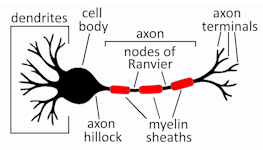
Neurons are the basic units of the nervous system. There are three types:
- interneurons connect neurons to other neurons
- sensory neurons convey information from tissues and organs to other neurons
- motor neurons transmit information from other neurons to effector cells in the body
The interneuron, shown above, evaluates the information coming from its dendrites (in a small region called the axon hillock) to decide whether it should “fire” or not. If the neuron fires, the signal travels down the axon to the axon terminals, where it is passed to another neuron.
To make this work, the neuron’s outer membrane contains
sodium–potassium pumps and ion gates. The sodium-potassium pumps run continuously to maintain the neurons resting state in which there is an electrical potential across the cell membrane. The ion gates are triggered at precise times to create the signal (spike, “action potential”) that moves along the axon.
Remarks:
- One-directional mechanisms of this sort are found throughout biology: Life depends on the Arrow of Time.
- The above description is an example of the Universe observing itself. I am using my neurons to describe neurons, and you are using them to read what I wrote. This is the familiar use/mention distinction that is important in programming. (This also resonates with Wolfram’s emphasis on “computation”).
- PerceivedTime is related to the firing of neurons not to clock time. We don’t have little mechanical clocks in our brains. I think perceivedTime is the perception of waves in the firings of swarms of neurons... Perceived time is what those waves mean (a quale).
Sodium-potassium pumps
These pumps run continuously to maintain different concentrations of sodium and potassium ions inside and outside the neuron.
Both the sodium ions (here, blue stars) and potassium ions (red disks) carry a positive charge. The pump opens and closes continuously, opening towards the outside of the cell when it receives energy from a phosphate delivered by an ATP protein.
The following cycle repeats about 100 times per second moving a maximum of two potassium ions and three sodium ions per cycle. In the absence of other processes, this maintains a stable electric charge of -70mV inside the neuron.
Both the sodium ions (here, blue stars) and potassium ions (red disks) carry a positive charge. The pump opens and closes continuously, opening towards the outside of the cell when it receives energy from a phosphate delivered by an ATP protein.
The following cycle repeats about 100 times per second moving a maximum of two potassium ions and three sodium ions per cycle. In the absence of other processes, this maintains a stable electric charge of -70mV inside the neuron.

- Potassium ions, collected during the previous phase of the cycle, are released into the interior of the neuron. The collected ions move into the neuron regardless of the current dominance of potassium ions already there.
- Sodium ions are collected by the pump while it is still open on the inside.
- Energy, provided by a phosphate coming from an ATP protein (dark blue triangle), causes the pump to change its configuration so that it opens towards the outside of the neuron. The collected sodium ions are released outside the neuron regardless of the current dominance of sodium ions already there.
- The ATP protein, having expended some energy, detaches from the pump, and two potassium ions are collected. When the energy has been used up, the pump opens again to the inside of the neuron, and the cycle continues.
Neurons have a structure that is on a higher level than that of the ions, so they must have evolved later, and the Universe must be evolving intrinsically. Reductionism is simply wrong.
Note carefully that
- The pumps cannot be run backwards (to create energy from the electro-chemical imbalance across the cell wall). Each pump embodies an irreversible function.
- The neuron uses a different irreversible function (using dendrite inputs) to output the stored energy as spikes (action potentials) — see below.
- The ions disperse naturally at each stage in the above cycle. The second law of thermodynamics (Entropy is always increasing) is never violated on the level of the ions.
Notes about Entropy
The Universe appears to have discovered how to store energy by running entropy backwards at the level of its neurons.
Entropy is a term that should be used with great caution: It is a technical term, used in mathematical physics, to denote a probability of disorder. It is not a physical quantity like energy, but an empirical description of how low-level particles behave in a higher level container when no extra energy is added to the system. Their intrinsic
vibration or positional uncertainty leads to their diffusion.
It’s a common mistake to think that a probability can cause anything:
It’s a common mistake to think that a probability can cause anything:
- Entropy cannot cause the Arrow of Time.
- Entropy cannot cause processes to be irreversible.
(The Wikipedia article on Entropy currently says: “A consequence of the second law of thermodynamics is that certain processes are irreversible”. Irreversible processes may be instances of the second law, but they are not consequences of it.)
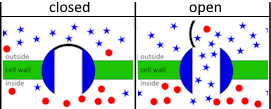
Sodium ion gate states
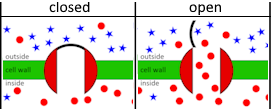
Potassium ion gate states
Action potential (spike, signal)
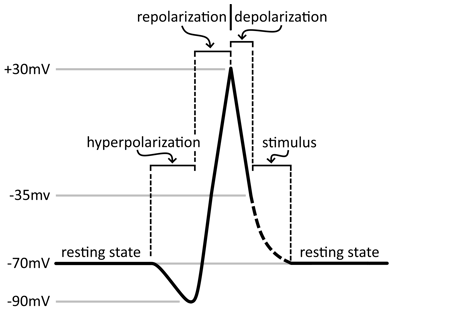
The spike is created in four stages between resting states:
- stimulus: If the stimulus creates a voltage greater than -35mV, the depolarization stage is triggered, otherwise no signal is created and, if no more stimuli arrive, the state returns to resting.
- depolarization: The sodium gates open, allowing sodium ions to enter the neuron. This increases the electric potential across the neuron's membrane from -35mV to +30mV.
- repolarization: The sodium gates close and the potassium gates open, allowing potassium ions to leave the neuron. This decreases the electrical potential across the neuron's membrane again. The potassium gates then begin to close.
- hyperpolarization: The potassium gates are completely closed when the potential reaches -90mV. This is a hyperpolarized state (a state less than the -70mV resting state). The sodium-potassium pumps (which run continuously) eventually restore the 70mV resting state potential.
The stimulus that creates such a wave, comes either from the axon hillock or from an existing wave in the axon. The sodium-potassium pumps take a little time to reset the resting state during hyperpolarization, so the wave is asymmetrical and always propagates from left to right in the above diagram (in one direction) along the axon.
This propagation process can be thought of as being like the falling of a row of dominoes whose “resting state” is “standing up”. Once they have fallen, the dominos have to be stood up again before another “signal” can be sent. In neurons “standing the dominoes up” is done continuously by the sodium-potassium pumps.
Many neurons are encased in myelin sheaths separated by “nodes of Ranvier”. In such neurons, the signal “jumps” from one end of a myelin sheath to the other, and ion gates only open and close in the nodes of Ranvier. This greatly increases the signal’s speed while reducing the energy needed to maintain it. Such sheaths are often found on longer axons — for example those connecting the feet with the backbone.
In humans, the slowest neurons (having no myelin sheets) have a signal speed of about 1 metre/second, while the fastest (with myelin sheets) have a signal speed of about 120 metres/second.
Probabilities
Entropy is an instance of a problem that affects all probabilistic descriptions: They are global descriptions of low level phenomena, and therefore cannot explain what is really going on at the lower level. "Entropy", for example, abstracts away the behaviour of the low level particles with which it deals, so can tell us nothing about why they disperse.
Current quantum physics also involves the use of probabilities. That does not, of course, mean I think it is wrong but, in spite of Bell’s inequality, I’m still open to the idea of low-level “hidden variables”. I think its possible for “hidden variables” to be completely inaccessible to our senses. Possibly they are detectable using experimental apparatus, possibly not.
Another way to deal with the situation is to “shut up and calculate”. In other words, forget about trying to say precisely what the mathematical symbols might mean in the real, perceived world, and just use them to make predictions. We may think that Schrödinger’s psi ( ψ ) has something to do with probabilities, but there’s no guarantee that that is the whole story.
See also collapse of the wave function.
Another way to deal with the situation is to “shut up and calculate”. In other words, forget about trying to say precisely what the mathematical symbols might mean in the real, perceived world, and just use them to make predictions. We may think that Schrödinger’s psi ( ψ ) has something to do with probabilities, but there’s no guarantee that that is the whole story.
See also collapse of the wave function.
In my own experience (music): probabilistic (“stochastic”) methods of composition were used during 20th century, but with limited success. They can be useful when dealing with large masses of information, where relations between individual events are unimportant, but are otherwise ineffective. In contrast, the classical rules of harmony and counterpoint determine audible relations that exist between particular,
perceived events.
We are still digesting the enormous changes that have come about due to technical advances in instrumentation (synthesizers) and audio production (DAWs etc.) but I expect local rules to emerge gradually over the next decades as the technology settles down and musicians converge on what they think sounds good.
We are still digesting the enormous changes that have come about due to technical advances in instrumentation (synthesizers) and audio production (DAWs etc.) but I expect local rules to emerge gradually over the next decades as the technology settles down and musicians converge on what they think sounds good.